

What Are DIN Rail Terminal Blocks?
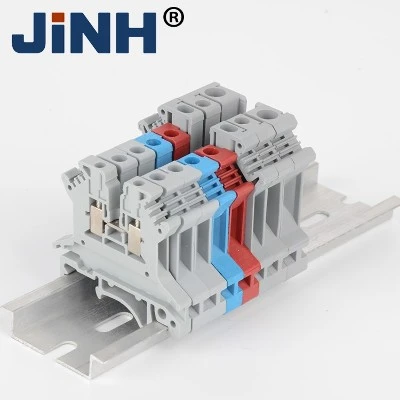
DIN rail terminal blocks are modern electrical connection components designed for quick and easy installation on standard DIN rails. Their compact design allows for efficient electrical connections in limited spaces, providing high reliability and ease of maintenance. These terminal blocks typically consist of a terminal block, a fixing clamp, and a DIN rail, facilitating stable connections between cables and circuit boards or equipment. DIN rail terminal blocks play a crucial role in the electrical and automation industries, making them indispensable components in modern electrical systems.
For example, the JHUK series terminal blocks adopt a screw-clamp connection design, compliant with IEC60947-1 and GB14048 standards. The JHUK series is suitable for circuits with an alternating current of 50Hz (60Hz) and a rated voltage of 660V or a direct current of 440V, with conductor cross-sections ranging from 0.75 to 150mm². These blocks are particularly suitable for connecting round copper conductors that have not undergone special processing or crimped with tubular terminals.
How Do DIN Rail Terminal Blocks Differ from Other Types of Terminal Blocks?
Installation Method:
DIN rail terminal blocks utilize a snap-in installation method, making the process quick and easy. The JHUK series terminal blocks can be used on both G-type and TH-type DIN rails, featuring strong versatility. Models below 50mm² also come with reinforcement accessories to ensure stable installation. In contrast, other types of terminal blocks, such as screw-type or soldered terminals, typically require additional tools for installation, making the process more time-consuming and complex.
Modular Design:
DIN rail terminal blocks support modular combinations, allowing users to flexibly configure and expand the terminal modules according to their specific needs. The JHUK series terminal blocks offer robust combination functionality, simplifying the conductor connection process. Other types of terminal blocks may lack this flexibility and expandability, making them less adaptable to changes.
Space Utilization:
DIN rail terminal blocks are designed to be compact, occupying minimal space, making them ideal for high-density wiring environments. The JHUK series terminal blocks are small, fully specified, and capable of connecting large cross-section conductors with excellent conductivity. Models below 50mm² use copper clamp frames and copper fastening screws to ensure efficient electrical performance. In contrast, models above 50mm² use steel clamp frames with steel screws and copper flow plates, enhancing structural strength while also featuring a self-locking function for reliable connections. Other terminal blocks may be larger and occupy more installation space, reducing efficient space utilization.
Ease of Maintenance:
DIN rail terminal blocks usually come with marking strips and test points, allowing users to quickly identify and troubleshoot issues during maintenance. The JHUK series terminal blocks' screw-clamp connection design, featuring a high tightening torque and a self-locking function, minimizes the risk of poor connections due to loosening, further enhancing maintenance convenience. Other terminal blocks might not offer the same level of ease in maintenance and repair.
Applications of DIN Rail Terminal Blocks
DIN rail terminal blocks are widely used in the following scenarios:
Industrial Automation:
In industrial automation systems, DIN rail terminal blocks connect PLCs, sensors, actuators, and other equipment, ensuring the stable operation of the entire automation system.
Electrical Control Cabinets:
DIN rail terminal blocks are used in electrical control cabinets to centralize cable connections, enhancing the reliability and maintenance efficiency of electrical systems.
Building Wiring:
In building electrical systems, DIN rail terminal blocks connect various electrical devices, contributing to cleaner and safer wiring.
Traffic Signal Systems:
DIN rail terminal blocks are widely used in railway and road traffic signal systems, ensuring accurate signal transmission and system stability.
Precautions When Using DIN Rail Terminal Blocks
Selecting the Right Model:
Choose the appropriate DIN rail terminal block based on the specific requirements of the electrical system, ensuring that the rated voltage, current, and other parameters meet the standards. For the JHUK series, it is essential to select the correct terminal block model according to the cable cross-section to achieve optimal connection performance.
Proper Installation:
Ensure the DIN rail is securely fixed, and the terminal block is correctly snapped into place to prevent poor contact due to improper installation. Models below 50mm² in the JHUK series require reinforcement accessories to ensure installation stability.
Wiring Standards:
Strictly follow wiring standards to ensure tight connections between cables and terminals, avoiding loose or poor contacts and ensuring electrical system safety. The JHUK series is designed for connecting round copper conductors that have not undergone special processing or crimped with tubular terminals, so special attention is needed during use.
Clear Labeling:
Use marking strips to clearly label the DIN rail terminal blocks, indicating each terminal's connection status for easier maintenance and troubleshooting.
Regular Inspection:
Regularly inspect and maintain the DIN rail terminal blocks to ensure stable connections without loosening or corrosion, preventing potential electrical faults. The self-locking function of the JHUK series helps reduce the risk of loosening, but regular inspection is still necessary.
Conclusion
DIN rail terminal blocks, with their easy installation, modular design, efficient space utilization, and ease of maintenance, play a crucial role in modern electrical and automation systems. By selecting and using DIN rail terminal blocks correctly, electrical systems' safety and reliability can be significantly improved, maintenance costs reduced, and overall work efficiency enhanced.